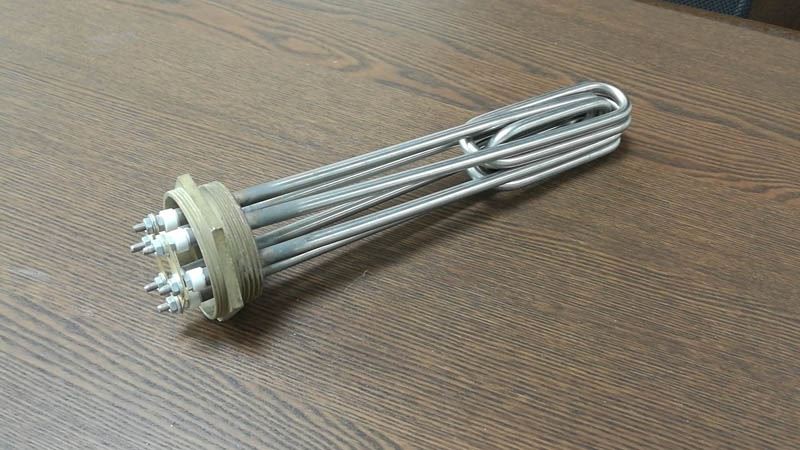
The influence of flange immerison heater heating on welding mark
What is the effect of heating with flange electric heater on the weld line?
When using a flange immerison heater for heating, the flow behavior is very complicated in the melt front area. Its flow pattern is like a fountain, and it flows out from the Zhongzhou white at the front of the fluid and flows to the wall of the mold cavity. In this case, when the two fluid fronts meet, the fluid at the center first contacts to form a welded area, then develops from the center to the mold wall in the radial direction, and finally forms a welded area. Therefore, the weld line is the boundary formed by the fusion of two or more melt flow fronts in the cavity. The thinning of plastic parts increases the mold filling resistance during molding. In recent years, flange electric heaters are widely used in diathermy forging in industrial production, including gear and shaft quenching. Flange electric heater is a kind of three-phase power frequency alternating current, which is rectified and becomes direct current, and then the direct current is changed into adjustable current, and the alternating current flowing through the capacitor and the induction coil is generated in the induction coil. The high-density magnetic field lines and the cutting of the metal material contained in the induction coil produce a large eddy current in the metal material. This eddy current also has some properties of medium-frequency current, that is, the free electrons of the metal itself flow in the metal body with resistance to generate heat. With the development of control technology and power semiconductor devices, the solid-state flange electric heater power supply has also developed by leaps and bounds. Since the 1950s, when a company in the United States developed the world's first commercial thyristor product, solid-state flanged electric heater power supply technology has received extensive attention worldwide and conducted in-depth application research on it. Its appearance has brought a new revolution to the induction heating technology and the entire power electronics field. With the deepening of research and the need of application, the induction heating technology and the power supply of electric flange heaters will surely be further developed and more widely used. In the high-frequency (above 100kHz) range, foreign countries are transitioning to modularized, solid-state MOSFET power devices based on transistorized solid-state power supplies. In 1989, Germany developed a current-type MOSFET induction heating power supply with a capacity of 480kW / 50 ~ 200kHz; Spain also produced a current-type MOSFET flange electric heater power supply with a capacity of 600kW / 400kHz: American Yingda Company also launched 2000Kw / 400KHz MOSFET flange electric heater. Application of surface quenching of electric flange heater:
Compared with ordinary heating and quenching, has:
1. The heating speed is extremely fast, which can expand the transition temperature range of A body and shorten the transition time.
2. After quenching, extremely fine cryptocrystalline martensite can be obtained on the surface of the workpiece, and the hardness is slightly higher (2 ~ 3HRC). Low brittleness and high fatigue strength.
3. The workpiece processed by this process is not easy to be oxidized and decarburized, and even some workpieces can be directly assembled and used after processing.
4. The hardened layer is deep, easy to control and operate, easy to realize mechanization and automation.